Once the wheels are clean, the caliper is the part you keep seeing through the spokes, especially in bright San Diego sun. Brake caliper painting in San Diego is a cosmetic finish on a heat-soaked brake part, not a brake repair. The real booking choice is paint, powder, or a ceramic-style topper, plus whether the pro removes the caliper.
What caliper coating is meant to change
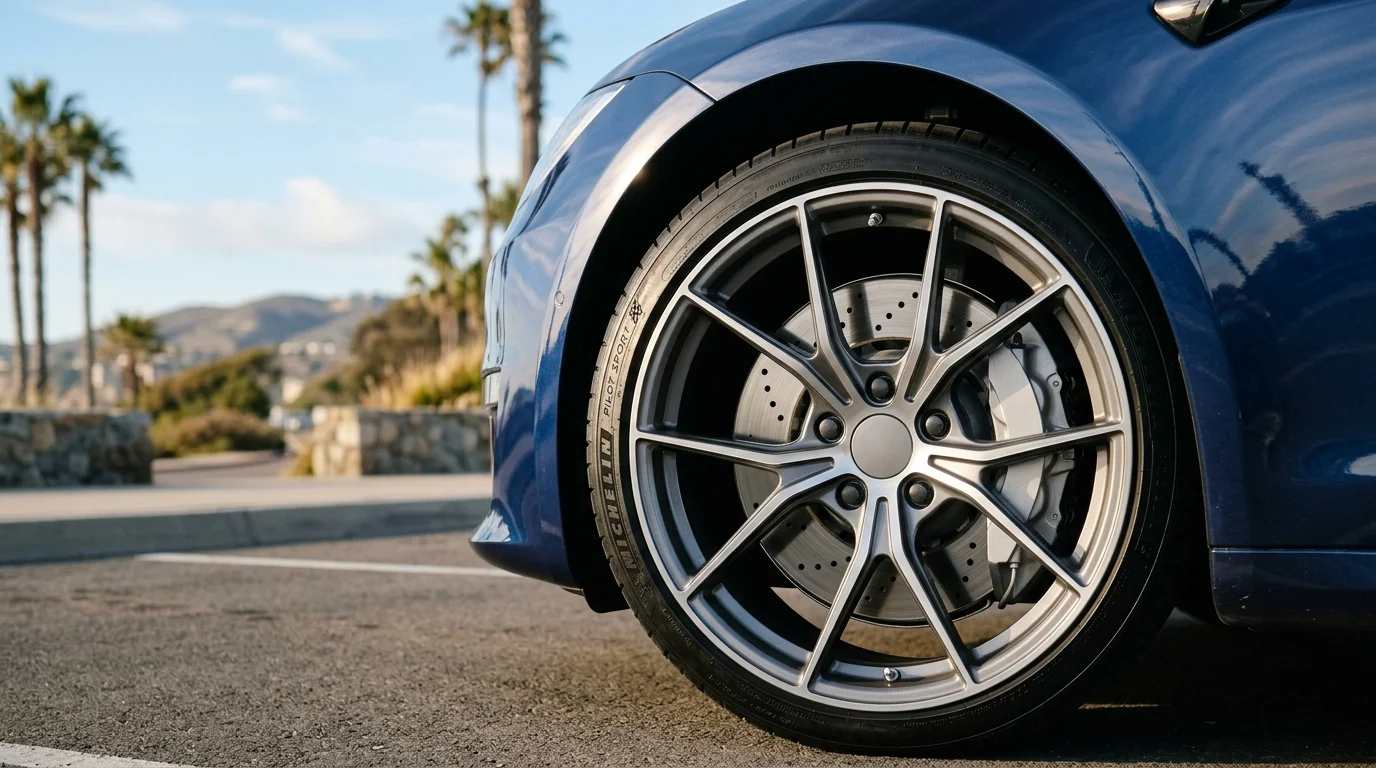
Caliper coating changes what you see through the wheel. Color, sheen, and contrast sit right behind the spokes. A faded factory casting or chalky old paint reads as unfinished even when the panels are sharp.
It does not restore braking. A coating will not free a sticky piston, stop a leak, or quiet a pad wearing on one side. If you feel a pull, smell hot brakes on the grade into El Cajon, or see fluid at the hose, that is a mechanical visit. Finish work waits until the caliper is healthy.
Owners usually want one of three looks. Match a set of aftermarket wheels. Recreate the factory red or yellow from a sport package. Cover rust bloom that shows after summers near the water in Pacific Beach, Mission Beach, Coronado, or Imperial Beach. A daily driver on I-15 through Mira Mesa and Rancho Bernardo often wants the same cleaner look without touching body paint.
Coastal cars pick up salt film. Inland cars in Santee, Lakeside, and Escondido see more heat soak from stop-and-go and canyon grades. A new finish can hide tired metal and make brake dust less obvious. It is not a confirmed rust-proof or fade-proof shell, and this page does not publish a color life in years. Your installer puts durability language in a written warranty.
The job is worth booking when the wheel package matters to you and the brakes already work. It is a weak spend if you are hiding a caliper that needs a rebuild. The wheel and caliper coating page is the booking lane. Paint Shield SD matches you with a vetted, insured local pro. That pro removes, coats, and reinstalls. You contract and pay the pro directly. Getting matched costs you nothing.
How paint, powder, and ceramic finishes differ in practice
Three finish families show up in San Diego quotes. They are not the same job.
Paint is a sprayed color coat over cleaned, prepped metal. Some installers name a high-temperature product on the quote. Work can happen with the caliper on the knuckle if masking is careful, or with the caliper off. Inner-face coverage follows prep and spray angle. Paint is the usual answer for caliper painting San Diego shoppers who want color without an oven cycle.
Powder coating is a dry powder applied to a prepared part, then cured with heat. That bake is why powder jobs almost always need the caliper off the car. Seals, boots, pistons, and fluid cannot stay in the part during a true powder cycle. The film is typically thicker than spray paint. We already compared that split in brake caliper paint vs powder coating. Use that page for process. Use this page to decide what you are buying locally.
Ceramic, on this site, means a liquid polymer that bonds to a prepared surface and leaves a hard, hydrophobic layer. It resists water, UV, and light chemical exposure. It does not absorb rock-chip impacts, and it is not a color-change paint by itself. On calipers, some independent pros apply a ceramic-style topper over a color coat. Ask for the product data sheet. Do not treat the word ceramic as a heat rating.
If you also care about the wheel face, keep that quote separate. Wheel ceramic coating in San Diego is about barrels and faces that see soap, dust, and curb rash. A ceramic coating in San Diego protects body panels. It does not stand in for a caliper refinish.
No finish on this page is approved as heat proof or chip proof. Color life is not a published number here. The installer confirms the system, the cure method, and the written warranty.
What removal, masking, and heat exposure change
The mechanical plan changes the finish more than the color chip does.
In-place work keeps the caliper on the car. The pro masks the rotor, the pads if they stay, the hose, the knuckle, and nearby suspension. Overspray on a rotor or a pad face is a safety problem, not a cosmetic one. Inner surfaces and the back of the body are harder to prep. There is no powder-cure oven in a wheel well. In-place is often the shorter shop visit. Masking quality is the whole job.
Removal work takes the caliper off. That lets the pro degrease, treat rust, and coat more of the casting. Pistons, boots, slides, and fluid have to be handled as brake parts. Reinstall includes specified hardware, hose routing, a bleed if the system was opened, and torque on the bracket bolts. Confirm who does that mechanical work. Coating a box of parts is a different booking than taking the car and putting it back on the ground.
Heat is the condition you cannot skip. Calipers live next to rotors. Coastal traffic on I-5 through Carlsbad and downtown, plus long grades in East County, both put heat into the part. A finish that looked perfect on a cold caliper in a Kearny Mesa bay still has to live there. Ask what the product literature says. This page will not invent a temperature number.
Salt air along the beaches and the bay is the other local stress. A wet overnight in a La Jolla or Point Loma garage shows prep shortcuts faster than a dry Rancho Bernardo driveway. The piston boot seal matters more than the color name.
Do not treat this as a driveway project. Opening a brake system, hanging a caliper, or spraying near a rotor is work for a pro. Paint Shield SD does not perform the work.
What a written scope should identify before booking
A useful quote is a parts list, not a color name.
It should say which calipers are in the job, fronts only or all four, plus the finish family, color, and sheen. Many San Diego daily drivers only show the fronts. Red is not a spec. Ask for the code or product line the installer will spray.
It should state on-car or off-car. If off-car, it should say who removes and reinstalls, whether the system will be opened, and whether a bleed is included. If on-car, it should say what gets masked and how the rotor and pads are protected.
It should say what happens to surface rust, old paint, and hardware. A scuff-and-shoot over loose rust is a different job than a strip and refinish. Keep wheel work as its own line if you want both.
Price belongs on that page in writing. For wheel and caliper coating work on this site, the live range is typically $300 to $700, depending on vehicle, how many corners, and whether wheels are in the same visit. Your installer confirms the written price. Getting matched costs you nothing.
Time is an expectation, not a promise. In-place paint can be a short shop visit, typically 1 to 3 hours on site. Removal, powder, and cure often take 1 to 2 days when the part comes off and goes through an oven. The installer confirms the schedule. Same-week scheduling is available for most services.
Warranty language, if any, comes from the installer in writing. Aftermarket appearance work generally cannot void a vehicle warranty merely because it was added. The federal Magnuson-Moss Warranty Act, explained by the FTC, is the authority for that general rule. Causation is still fact-specific.
Questions to ask an independent caliper pro
Ask these before you pick a color.
Will you paint, powder, or apply a color coat with a ceramic-style topper? What is the exact product, and can I see the data sheet?
Do the calipers come off? If they stay on, how do you mask rotors, pads, hoses, and sensors? If they come off, who reinstalls them, and is a brake bleed in the quote?
How do you handle piston boots, slide pins, and rust in the casting? What hardware gets replaced?
What is in and out of the written warranty? Heat discoloration, stone hits from canyon roads, and tunnel-wash chemicals are the failure modes to name. If those are excluded, you want that on paper.
What is the written price for my car, with photos of the current calipers? How does that sit inside the typical $300 to $700 wheel and caliper coating range?
Where is the work done? Mobile caliper painting exists in the wider market. Confirm what the specific pro offers. A driveway visit cannot run a powder oven. If you searched caliper painting near me, compare removal, masking, cure method, and who owns the brake reinstall, not just the color book.
Paint Shield SD refers. The independent pro coats. You want a vetted, insured local installer. There is no California contractor license for this trade, so licensed is the wrong word to listen for.
When to call us
Call when you want a caliper color change on a healthy brake system, and you need a pro who will put removal, finish type, and price in writing. Paint Shield SD matches car owners with vetted, insured local Ceramic Coating and Paint Protection Film pros. Call us at (760) 400-6557 and we’ll connect you with a vetted, insured local pro.