Yes. You can mix clear PPF and colored PPF on one car. Independent installers in San Diego County do it by putting one film on each panel and meeting the two finishes at a factory gap. Confirm the exact films and the panel map with the installer before anything is cut, because a universal mixing rule could not be confirmed here.
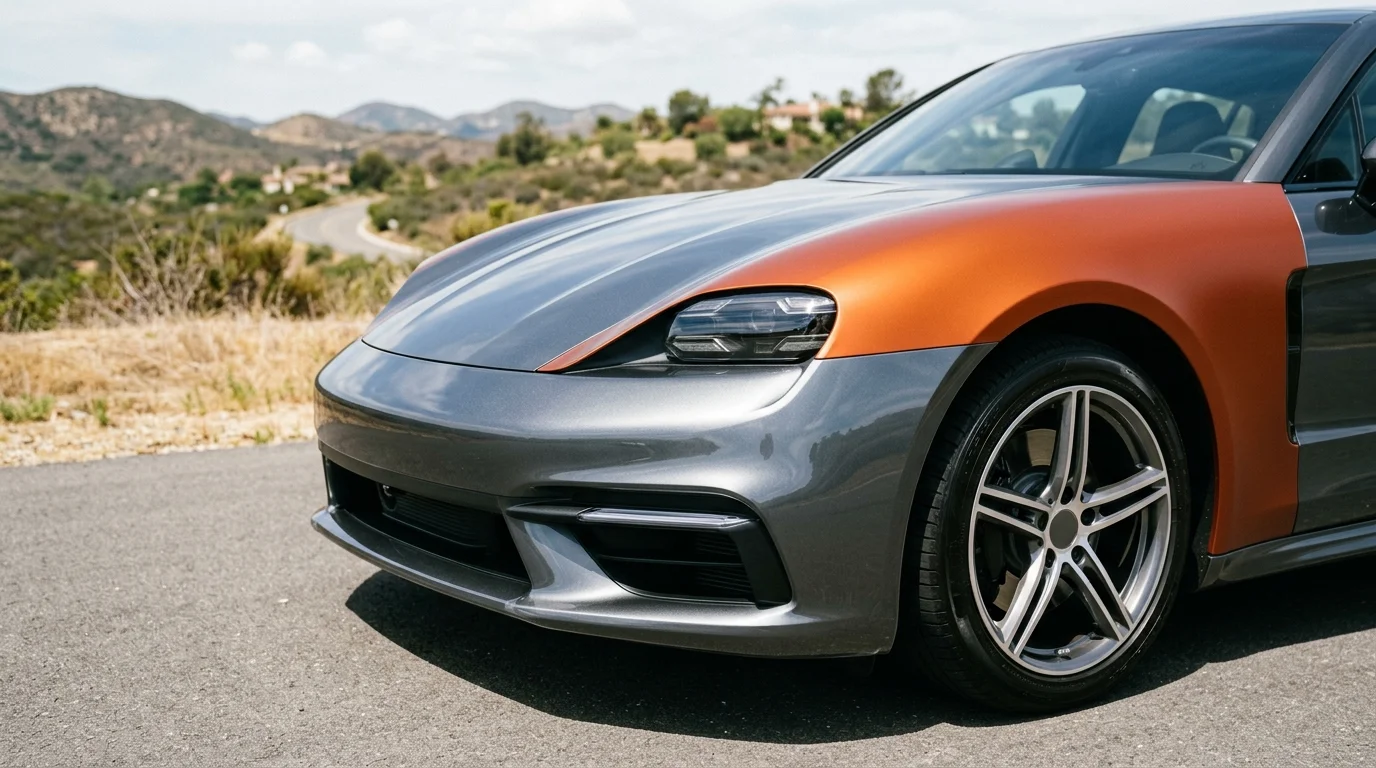
What mixed clear and colored film is meant to change
A mixed job is a split spec. Colored paint protection film changes the color or finish on the panels you pick. Clear film leaves the factory paint showing on the rest, and still takes rock chips, light scratches, and road debris.
Owners ask for this split for two jobs on one body. They want a two-tone look without a respray. They also want invisible protection on the panels that eat grit. On a daily driver that runs I-15 through Escondido or I-5 through the South Bay, the front bumper, hood, and mirrors take the hits. The roof, trunk lid, and mirror caps often carry the color.
Clear film is the keep-the-paint-you-bought path. Colored film is the change-the-look-and-still-shield-the-paint path. Running both on one vehicle is how those two jobs share a car. If you are still choosing the material itself, that comparison lives on colored PPF vs vinyl wrap and on the vinyl wrap color change service page. This page stays on the mix: clear film and colored film on the same vehicle.
Some paint protection film uses urethane with a self-healing top coat for light surface scratches. That coat does not heal punctures, deep damage, or the paint underneath. Colored film and clear film can both sit in that family. They still read differently next to each other, because one is transparent and one is not.
The mix is meant to put protection and a color change on a panel map you can see in writing. Professional removal on healthy factory paint is the normal case. Failing or previously resprayed paint is the risk case, which is why the installer inspects first. Ceramic coating is a liquid polymer that bonds to paint and creates a hard, hydrophobic surface. It resists water, UV, and light chemical exposure. It does not absorb rock chip impacts. Film is the physical shield. A coating over film is a later conversation, with its own prep rules from the installer.
Finish language belongs on the colored and matte PPF finishes page. Gloss next to gloss is one look. Satin or matte next to factory gloss is a design choice you make on purpose. The mix only works if that choice is written into the map before film is cut.
Where the two finishes usually meet on a car
The two films meet where the body already breaks. Hood to fender. Bumper to fender. Roof to A-pillar. Door to quarter. Those factory gaps already exist. The eye expects a line there. A transition that cuts across the middle of a flat panel is held only by a film edge. That edge is what people notice in a Mission Valley parking garage or a Del Mar beach lot.
There is no single correct panel map. The map answers three questions at once. Which panels take the most impact. Which edges will show. How much two-tone you want to read from the street. A common split puts clear film on the front bumper, hood, fenders, and mirrors, then colored film on the roof. Another split colors the hood and roof and keeps the doors clear. A third colors mirror caps and a spoiler and leaves the rest of the factory paint under clear film. The installer draws the map on your car, not on a generic sedan.
San Diego driving shapes that map more than a catalog photo does. Rock chips come off I-8 through Mission Valley, SR-52 into Santee, and I-805 in the South Bay. Coastal cars that sit in Encinitas or Carlsbad salt air pick up a different kind of dirt than inland cars that bake in El Cajon or Escondido. The climate does not invent a mixing rule. It does tell you which panels you want protected even if you never change their color.
Place the break at a panel gap or a factory body line. Ask the installer to show you that line in person, in daylight, and under shop lights. Gloss colored film next to gloss clear film over factory paint should read as one continuous sheen if both films are in the same finish family. Introduce a matte or satin film on one side of the break and the mismatch becomes the look. That can be the point. It has to be chosen, not discovered after install.
Door jambs, bumper returns, and tight inner edges are part of the map too. Ask what gets film, what stays bare paint, and where an edge will sit. A mixed job has more of those edges than a single-film full body. Every edge is a place water, wash brushes, and parking bumps will test later.
How paint condition and coverage maps affect the look
Paint condition decides whether the mix looks like a plan or a patch. The installer inspects first. Machine polishing can improve swirl marks, water spots, light scratches, and oxidation in the clear coat. The installer assesses the paint and quotes the safe stage before any film. That step matters more on a mixed car, because clear film shows the factory color at full strength next to a colored panel. Any dull hood or swirled fender will sit right beside a fresh color block.
Failing clear coat, a prior respray, or a panel that was already blended is the risk case. Film adhesion can lift failing clear coat. Wrap work has the same limit. The honest move is to let the installer say which panels are ready and which need conventional repair first. Getting matched and getting that in-person look costs you nothing. You pay the installer you choose for the work.
Coverage maps change the look as much as color does. A full-front PPF package of clear film with colored film on the roof is a different car than a full-body PPF package with two colors. Partial coverage leaves bare paint at the edge of the last filmed panel. On a mixed job that bare paint can sit next to both a clear panel and a colored panel. Ask to see that three-way meeting in the drawing.
Gloss matching is a paint-and-map problem, not a later polish trick. If the factory paint is gloss, gloss clear film and gloss colored film are the pair that tries to read as one surface. If you want a stealth roof, that is a finish decision. Read the finish options on the matte page, then bring that choice back to this map. Do not assume two films from two catalogs will share sheen, texture, or aging. Ask the installer to confirm the exact films will sit next to each other on your paint.
San Diego light is harsh on mismatches. Noon sun in Mission Bay and late light on Harbor Drive both show a gloss gap that indoor photos hide. Ask for a sample of each film on a painted test panel, or on a hidden spot the installer is willing to use, before you lock the map. A sample on a white Camry will not tell you how a dark metallic SUV from Poway will read.
Existing wax or coating can interfere with film adhesion. The film installer specifies prep. Do not assume a coating already on the car can stay. Do not assume a clay bar is the next step without that advice. Clay is a decontamination step after a wash and before coating. It is not paint correction, and it is not a default move on film.
What a written quote should specify for each panel
A mixed job needs a panel-by-panel quote, not a single line that says “PPF.” Ask for a list that names every panel, the film on that panel (clear or colored), and the finish. Hood, fenders, bumper, mirrors, roof, doors, quarters, rockers, trunk, spoiler. If a panel is split, the quote should say so in words you can reread.
The quote should also name prep. Which panels get correction. Which panels are filmed as-is. Where edges wrap into jambs or stop at the gap. What happens to sensors, cameras, and emblems. Paint protection film in San Diego is typically quoted from $800 to $8,000 depending on vehicle size and coverage, and your installer confirms the written price. A mixed map can sit anywhere in that range because coverage, not the word “mix,” drives the ticket.
Time on the car is an expectation, not a promise. Full-body PPF is typically 3 to 5 days for a standard vehicle. Extra days apply when paint correction is included. Same-week scheduling is available for most services. “Same day” is not how this work is booked.
Warranty language belongs in that same document. Your installer confirms the film warranty in writing. Ask whether clear film and colored film are listed as separate items, and what a later repair on one panel does to the other. A chip on a clear bumper is a different repair from a scratch on a colored roof. The quote should say how a replacement panel is matched later.
A stacking rule for putting colored film over clear film on the same panel could not be confirmed on this site’s claims list. Ask the installer whether each panel gets one film, and whether those two products are meant to sit on adjacent paint. Confirm lot, finish, and care sheet for both. Brand names stay off this page. Ask for the product tier the installer recommends, then read the sheet they hand you.
If you are still deciding whether colored film is the right restyle tool, use what to compare on colored PPF in San Diego for the booking checklist. Bring that comparison back to this quote so the mix is specified, not implied.
Questions to ask an independent installer
Ask these out loud before you approve a mixed map.
Where does color stop, and which factory gap holds that line. Have them point at the car.
Does each panel get one film. If any panel would get two layers, have them explain why, in writing.
Are the two films in the same finish family. Gloss with gloss. Satin with satin. If they differ, that is the two-tone.
What prep does each panel get. Correction, decontamination, and any coating removal are part of the job, not extras you discover later.
How is the film warranty written for each film. Get it on paper.
How do you wash it. Follow the installed product care sheet for soap, chemicals, and timing. Avoid brush tunnels. Manufacturer care advice can discourage pressure washing and automatic washing because of edge lifting. That matters more on a mixed car because you have more edges. Compatible maintenance toppers only. Do not assume carnauba wax belongs on the film.
A federal rule is worth knowing if factory warranty talk comes up. Under the Magnuson-Moss Warranty Act, enforced by the FTC, a vehicle manufacturer generally cannot void a warranty merely because an aftermarket product was used, absent a showing that the product caused the failure. That is not the same as “your warranty is protected.” Causation is fact-specific. Never treat a mixed film job as legal advice on a warranty dispute.
Worth is personal. Clear film on the front of a leased car that commutes I-15 is a protection buy. Colored film on a roof you want to see from a patio in North Park is a style buy. The mix is how those two buys share one vehicle. Ask the installer to price the map you actually want, then decide.
Paint Shield SD matches you with vetted, insured local installers. The brand does not install film, hold a trade license, or set the shop’s price. You contract with the pro. Getting matched costs you nothing.
When to call us
A mixed clear and colored film map is shop work. You want an independent installer to inspect the paint, draw the panel breaks, and put both films in a written quote before anyone cuts a sheet. Call us at (760) 400-6557 and we’ll connect you with a vetted, insured local pro.