People searching auto ceramic coating services in Del Mar CA are usually comparing two cars that do not live the same life. One sits open near the sand. One sleeps in a garage off Via de la Valle. Start with that parking pattern, the paint in front of you, and whether Camino Del Mar grit belongs in a film quote too.
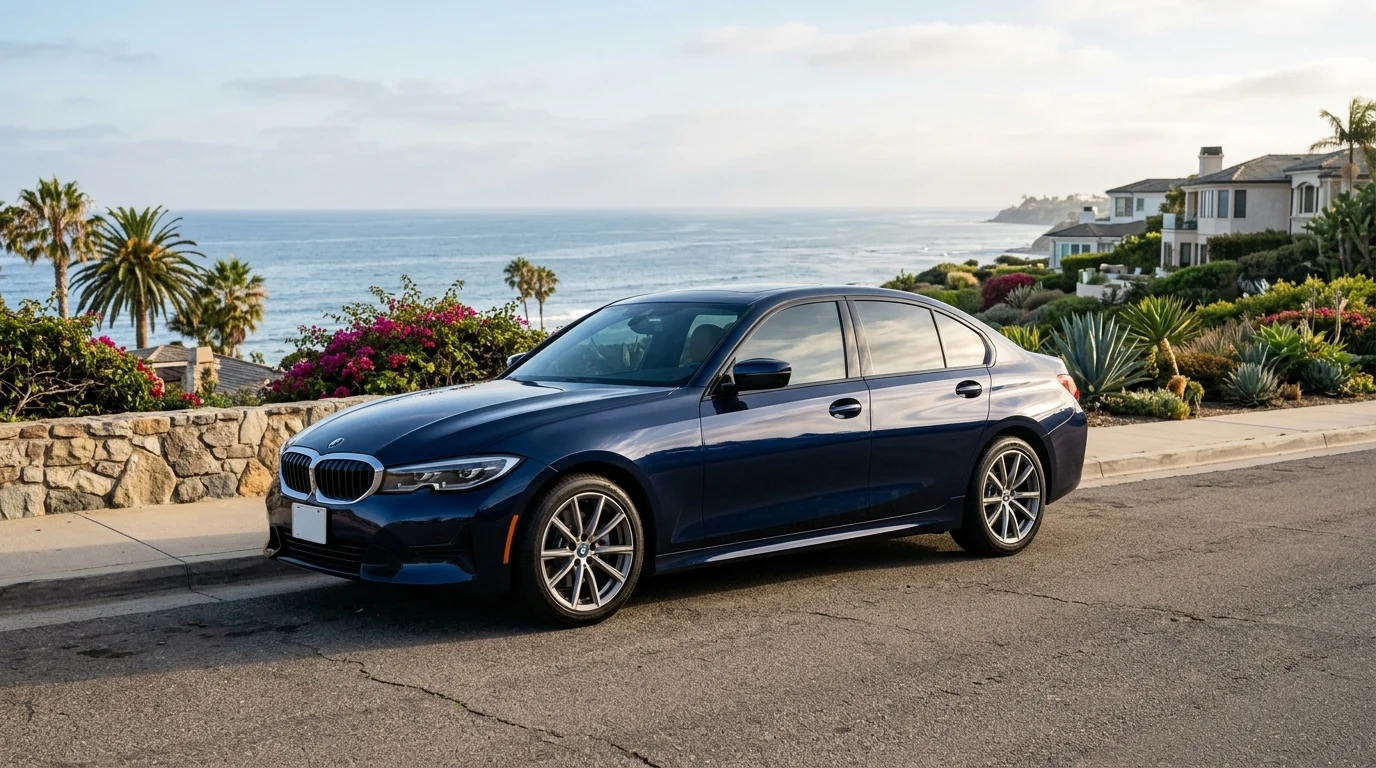
Start with paint condition and how the car is parked
Ceramic coating is a liquid polymer that bonds chemically to paint. It creates a hard, hydrophobic surface layer. It resists water, UV, and light chemical exposure. It does not absorb rock chip impacts. If the clear coat already holds swirl marks, water spots, light scratches, or oxidation, the coating locks those in. The first comparison is the paint, not the bottle.
A vetted, insured installer should inspect the car in person and quote the safe polish stage before any coating. Machine polishing can improve those defects. That is a trade assessment, not a promised result. For the Del Mar defect list, lighting, and what to look at before polishing, use paint correction in Del Mar: what to inspect. Keep that post for correction. Keep this one for booking the coating.
Parking decides how fast the paint picks up film. Overnight street parking on Camino Del Mar, or in the beach lots near 15th Street, leaves the car in marine air and morning dew. A closed garage inland from the bluff, or a structure off Via de la Valle, keeps the paint drier overnight. Plenty of Del Mar cars split the week: beach on Saturday, garage on work nights. Write that mix down. Do not let a pro treat every local car as a salt-soaked daily.
Ask for the parking note on the written quote. Street, carport, or garage. How often the car sits at the beach. That note should drive wash advice later, including coastal salt air care for ceramic coating in San Diego. Salt film is a wash and maintenance issue. It is not a reason to promise a salt-proof finish.
Clay bar work belongs in this first look too. Clay is a decontamination step after a wash and before coating. It is not paint correction. There is no yearly clay schedule we can publish as fact. Do not clay a coated car without the installer’s advice.
If the paint is still unmarked factory clear, the scope is simpler. If it is a swirled daily driver, correction comes first. Either way, ceramic coating is the service you are comparing. The Del Mar booking still starts with paint and parking.
How Camino Del Mar and fairgrounds traffic change the job
Camino Del Mar is the town’s coastal spine. It carries local trips, beach-lot turnover, and visitors hunting for the next curb space. Stop-and-go traffic, tight parking, and sand on the asphalt show up on lower panels, rockers, and bumper corners. That wear is not the same on every car. A short hop to 15th Street is a different week than a daily run the length of town.
Via de la Valle is the east-west cut to I-5 and the Del Mar Fairgrounds. Fair dates and race dates pack that corridor with extra cars, extra grit in the lots, and extra door traffic. The rest of the year is quieter. Ask the installer to treat peak-event parking as a separate exposure, not as the year-round default. A car that only sees the fairgrounds in June is not the same job as a car that parks there every weekend.
Coating does not swallow rock chips. Paint protection film is a flexible thermoplastic film that physically shields paint from chips, scratches, and road debris. Some films can self-heal minor surface marks with heat. They do not heal punctures, deep damage, or weak paint underneath. If Camino Del Mar curb work and Via de la Valle freeway on-ramps are part of the week, put film on the table with the coating, not after the coating is already on the nose.
The written quote should name the panels that take the grit: front bumper, hood, mirrors, fenders, and rockers. A Del Mar commute that uses Jimmy Durante Boulevard toward the fairgrounds, then Camino Del Mar for errands, can justify a full-front film talk. A garage-kept car that barely leaves the village may not. Compare the route, not a county-wide average.
Searchers looking for the best ceramic coating services in Del Mar CA are usually sorting this traffic question. The stronger quote names Camino Del Mar, Via de la Valle, and fairgrounds lots in plain language. The weaker quote could be copied onto an El Cajon page with the city swapped. Local coating work has to sound like this coast.
What preparation should appear in the written scope
Independent pros perform the coating. You should see the prep in writing before anyone books the bay. A useful scope lists the wash, the decontamination step, whether clay is included, and whether paint correction is part of this job or a separate visit. It should also list which surfaces get coated: painted body only, or wheels, calipers, trim, and glass as extras.
Cure time and shop conditions belong on that page too. Ceramic coating work typically runs 1 to 2 days. Extra days are common when paint correction is included. Those are expectations. They are not a scheduling promise. Same-week scheduling is available for most services. Your installer confirms the calendar after they see the car.
Price belongs in the same document. Ceramic coating in San Diego typically runs $500 to $3,000, depending on vehicle size, paint condition, and prep. Your installer confirms the written price. Getting matched costs you nothing. For how those ranges move with size and correction, read ceramic coating cost in San Diego. Do not treat a phone number as the bill.
The scope should also say what the installer will not coat until the paint is sound. Failing clear coat, a recent respray, or a panel that still holds bonded fallout is a pause, not a rush. Professional coating on healthy factory paint is the normal case. Previously resprayed paint is the risk case, which is why the inspection comes first.
Ask who does the work and who you pay. Paint Shield SD matches you with a vetted, insured local pro. You contract with that installer. You pay that installer. If you want the Del Mar service page in one place, use auto ceramic coating services in Del Mar. The written scope is still the document that decides whether the booking is real.
When PPF should be discussed with coating
Bring film into the coating talk when the car takes chips. Camino Del Mar sand, Via de la Valle on-ramps, and fairgrounds lot gravel are chip sources. Coating resists water, UV, and light chemical exposure. It does not absorb those impacts. If the nose, mirrors, and bumper already show pits, coating them first only makes later film more awkward.
Paint protection film is the physical layer. A full-front package covers the panels that see the most debris. A full-body package is a different job, typically quoted over several days on a standard vehicle. The installer inspects first because film removal on healthy factory paint is the normal case, and failing or resprayed paint is the risk case. Your installer confirms the film warranty in writing. Do not borrow a year-count from a brochure.
Coating over film is a common pairing when both are planned together. The film installer specifies prep, because existing wax or coating can interfere with adhesion. Manufacturer care advice can also discourage brush and automatic washing because of edge lifting. Do not generalize one product’s wash wait, pressure setting, or exclusions. Ask for the care sheet that matches the film on your car.
Wheels and headlights are separate decisions. Road grit on Camino Del Mar hits the leading edges first. Headlight film and wheel coating are extras, not automatic add-ons. Keep them on the quote only when those parts matter to you.
If you are still weighing coating alone against film plus coating, is ceramic coating worth it is the county-wide value read. In Del Mar the value question is narrower: does this car take chips on the nose, or does it mostly need a hydrophobic wash layer on paint that already lives in a garage.
What product and aftercare details to confirm
Stay brand-agnostic. Ask for the product data sheet and the written warranty from the installer. This site does not name coating brands, and it does not publish a lifespan in years. Graphene is a marketing name used on some liquid paint coatings sold next to ceramic coatings. Comparison pages disagree on durability, heat, and water spotting. Do not treat the label as a stronger chemistry. Ask for the sheet.
Aftercare should be specific to the product that landed on the car. Avoid brush tunnels. Follow the installed product care sheet for soap, chemicals, timing, and whether a touchless wash or a pH-neutral hand wash is listed. Generic care guidance often starts with a pre-rinse, a gentle hand wash with clean microfiber and a compatible neutral soap, then a rinse and a dry. Do not let mineral-bearing water air-dry on the paint. Product instructions still control the chemicals and the timing. There is no universal booster calendar we can publish.
Compatible maintenance toppers only. Do not assume carnauba wax is suitable on a coating. Ceramic maintenance visits in this market typically run $150 to $350, depending on scope. Your installer confirms the written price. If you want a planned wash rhythm, ask about a ceramic maintenance program after the coating is on, not before the scope is signed.
Factory warranty questions come up on newer Del Mar cars. The federal Magnuson-Moss Warranty Act, explained by the FTC, is the authority for this point: a vehicle manufacturer generally cannot void a warranty merely because an aftermarket product was used, unless it shows that the product caused the failure. That is not the same sentence as “your warranty is protected.” Causation is fact-specific. Do not treat a coating receipt as a warranty ruling.
Confirm who you call for aftercare questions. Confirm what happens if a panel needs film later. Confirm the wash method in writing. Those three lines separate a Del Mar coating booking from a product pitch.
When to call us
Call when you want auto ceramic coating in Del Mar compared against your paint, your parking, and the grit on Camino Del Mar and Via de la Valle, with independent pros doing the work. A vetted, insured installer should inspect the car, write the prep, and tell you whether film belongs on the nose before anyone coats it. Call us at (760) 400-6557 and we’ll connect you with a vetted, insured local pro.