A clay bar is not a default yes on installed paint protection film. Film care is product-specific, and this site could not confirm a universal rule that covers every film on the road. If your car already has paint protection film in San Diego County, stop before you drag clay across it. Ask the independent installer who maintains the film, and read the film maker’s care sheet, before any clay contact.
Clay is a decontamination step, not paint correction. People reach for it when a washed panel still feels gritty. On bare paint, that step often happens before a coating. On installed film, the face is different. The wrong pass can haze a clear bra that was still doing its job.
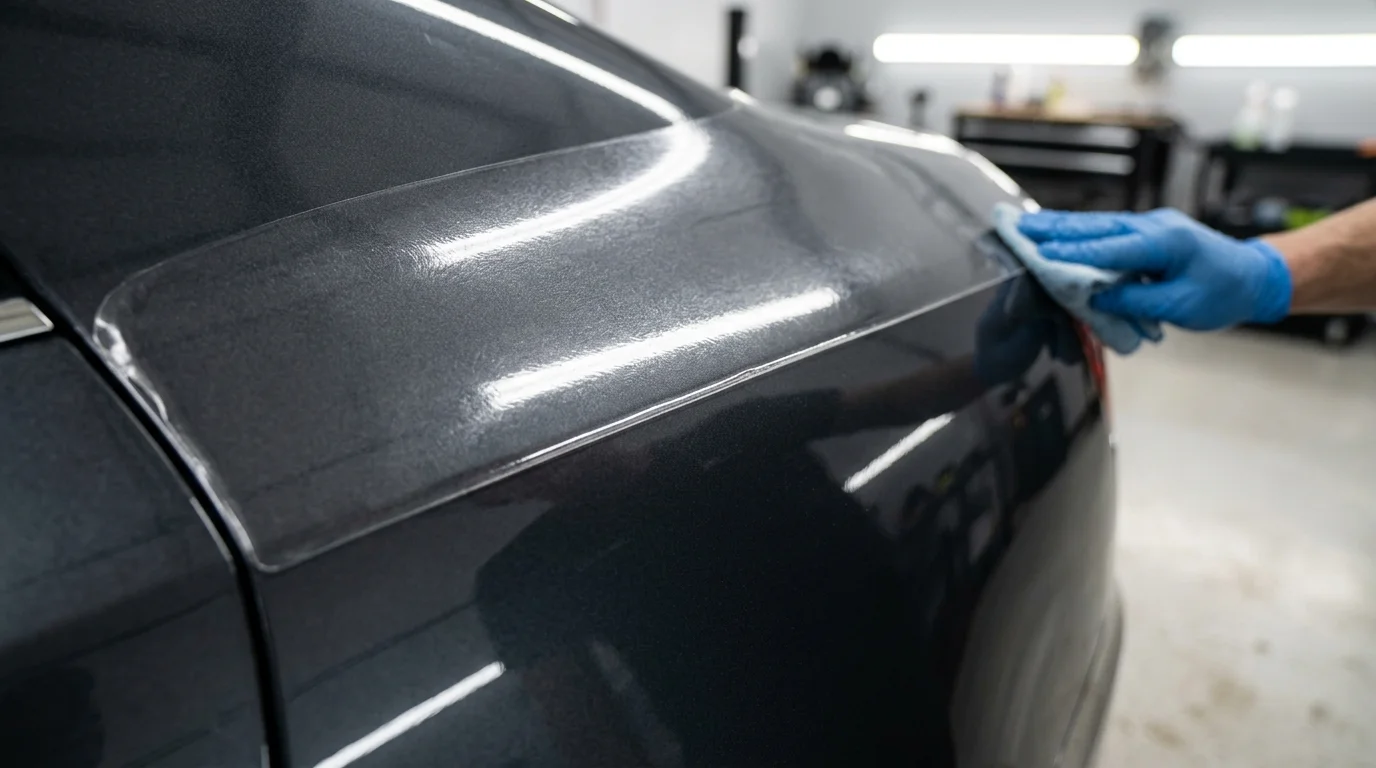
Why people reach for clay after film is already on
The car still feels rough after a wash. That is the usual trigger. Coastal cars from Imperial Beach up through Oceanside pick up salt film and marine-layer spotting. Inland cars from El Cajon, Santee, and Escondido pick up dry dust. Commuters on I-15, I-8, and SR-163 collect brake dust on the same hoods and bumpers the film was meant to save.
The film did not fail when that grit shows up. Paint protection film is a flexible thermoplastic layer on top of the paint. It takes the chips. The outer face still lives in the air you drive through. Bonded fallout can sit on that face the same way it sits on clear coat. A week of beach parking at Mission Bay, or a dry-wind week in East County, can leave a hood feeling sandy even when it looks clean.
Owners then copy the paint playbook: wash, clay, then coat or wax. That playbook is for paint. It is the subject of our clay bar before ceramic coating guide, which covers prep before a coating goes on paint. This page is about film that is already on the car. Mixing those two jobs is how a clay bar ppf question turns into a scratched top coat.
Feel is the second reason. Clay is famous for making paint feel like glass. On film, that glass-smooth goal can fight the film maker’s own care rules. A third reason is a ceramic topper. Plenty of San Diego hoods have film and a coating stacked. Existing care on this site is plain: do not clay a coated car without the installer’s advice. If you cannot see where the film ends and the coating starts, that is another reason to stop and have a pro look.
People also search “can you clay bar ppf” after a tunnel wash. Brush tunnels are a poor match for filmed and coated cars. If a tunnel already chewed the face, clay is not the first fix. The panel needs an inspection, not more friction.
How a clay bar and a film surface differ
A clay bar is a tacky resin that grabs bonded bits as it glides. It is not a polish. It does not correct swirls. On paint, that grab is often useful after a wash and before a coating. Installed film is not paint. Some paint protection film uses urethane with a self-healing top coat for light surface scratches. That top coat does not heal punctures, deep damage, or the paint underneath. Clay is friction. Friction on a softer, more flexible face is not the same as friction on factory clear coat.
This site does not have a confirmed clay grade, lube, pressure, or pass count that is safe on every film. Pages that rank for this search often prescribe a fine-grade bar and a home sequence. Those instructions are not in our claims ledger, so they are not a method we can hand you. If a film maker publishes a care sheet that allows or forbids clay, that sheet controls. If the sheet is silent, treat clay as unconfirmed. Ask the independent pro who inspects the film.
The coating case is separate again. Ceramic coating is a liquid polymer that bonds to a surface and leaves a hard, hydrophobic layer. It resists water, UV, and light chemical exposure. It does not absorb rock chips. Clay on a coating can change how that layer feels and how it beads, even when it does not strip the coating in a dramatic way. That is why the standing rule stays simple. Do not clay a coated car without the installer’s advice.
If you are asking both “can you clay bar paint protection film” and whether clay messes up a ceramic coating, you are often describing the same car. Film plus coating is common on hoods and bumpers here. The answer still starts with inspection, not with a kit from a parts aisle. Want a coating on film later? That is a different job. Ask the same pro. Do not clay first as a shortcut to that work.
When an independent pro should inspect the film first
Have a pro look before any clay if any of this is true.
The film is still inside the installer’s written aftercare window. That window is not a number this site can invent. The installer who applied the film sets it.
Edges look proud, dry, or starting to lift. Manufacturer care advice can discourage pressure washing and automatic washes because of edge lifting. Clay dragged over a lifting edge is a way to make that worse.
You see haze, micro-marring, or a cloudy patch in hard light. Parking-garage light downtown, or low sun on a west-facing driveway in Point Loma, will show that faster than a phone photo.
The panel already went through a brush tunnel. Avoid brush tunnels on coated and filmed cars. If a tunnel marked the face, clay is not the opening move.
You cannot tell film from paint. Some installs are hard to see. If you are not sure the panel even has film, have a pro confirm in person before you treat it like bare clear coat.
There is a coating on the film, or you think there might be. Same rule as above.
The car sat in wildfire ash, heavy sap, or cement dust. Those are bonded messes. They are also easy to grind in if you clay a dry or wrong face.
An independent detailing specialist inspects and maintains the film. Paint Shield SD refers only. We match you with vetted, insured local pros. We do not clay the car. We do not own the film warranty. The pro who looks at the panel is the person who should say whether clay belongs in that visit.
What product and aftercare details to confirm in writing
Ask for the product name on the film, the care sheet, and the written warranty. This site is brand-agnostic. We do not name film lines. Your installer should. Confirm these points in writing.
Whether the film maker allows clay, forbids it, or is silent. Whether a ceramic topper is on the film, and whether that topper’s care sheet allows clay. What soap, chemicals, and wash method the care sheet lists. Compatible maintenance toppers only. Do not assume carnauba wax is suitable on a coating. Whether a touchless wash or a pH-neutral hand wash is the listed method. Any wait after install before aggressive cleaning. What the warranty excludes if you clay the film yourself.
Those answers will not be the same for every car in the county. A full-front film on a truck that lives in Alpine is not the same stack as a clear bra on a coupe that parks in La Jolla. The installer specifies prep and care. Existing wax or coating can interfere with film adhesion on a new install, which is why prep is their call, not a forum’s.
Keep the care sheet with the car. San Diego ownership changes. The next person to wash the car, a spouse, or a detailer in a driveway in Chula Vista, needs the same rules.
Federal warranty law is not a clay-bar permission slip. The Magnuson-Moss Warranty Act, explained by the FTC, is the rule that a vehicle manufacturer generally cannot void a warranty merely because an aftermarket product was used, unless that product caused the failure. That is about the factory paint warranty. It does not tell you clay is safe on film. Causation is fact-specific. Never treat that statute as aftercare, and never treat it as advice on a warranty dispute.
When a wash or maintenance visit is the better next step
Most grit on filmed cars here is still wash work. Washing a car with ppf and how to wash ppf and ceramic coating cover that path. This page will not repeat those steps.
Generic care we can state is modest. Pre-rinse dirt. Hand wash with clean microfiber and a compatible neutral soap. Rinse and dry. Do not let mineral-bearing water air dry. Avoid brush washes. Product instructions still control the chemicals and the timing. This site does not publish a wash interval, a booster interval, or a clay calendar. It also does not publish a yearly clay frequency. Those numbers could not be confirmed.
If the car still feels rough after a correct wash, a ceramic maintenance program visit is the better next step than a home clay bar. Independent pros can judge whether the roughness is fallout, water spotting, film wear, or a coating that is thinning. They can also say whether clay belongs in that visit at all.
A maintenance visit is also the right call when you want a coating refreshed on film, or when you are comparing film-plus-coating care after a summer of I-5 beach runs. Same-week scheduling is available for most services. Getting matched costs you nothing. The installer you choose confirms the written price.
If the film is failing, stop cleaning as a hobby. Lifting edges, yellowing, and deep hits are replacement questions, not clay questions. The pro who inspects the panel should say so in person.
When to call us
If installed film feels gritty, looks hazy, or you are not sure clay belongs on it, stop and have an independent Ceramic Coating and Paint Protection Film pro inspect the panel. Call us at (760) 400-6557 and we’ll connect you with a vetted, insured local pro.