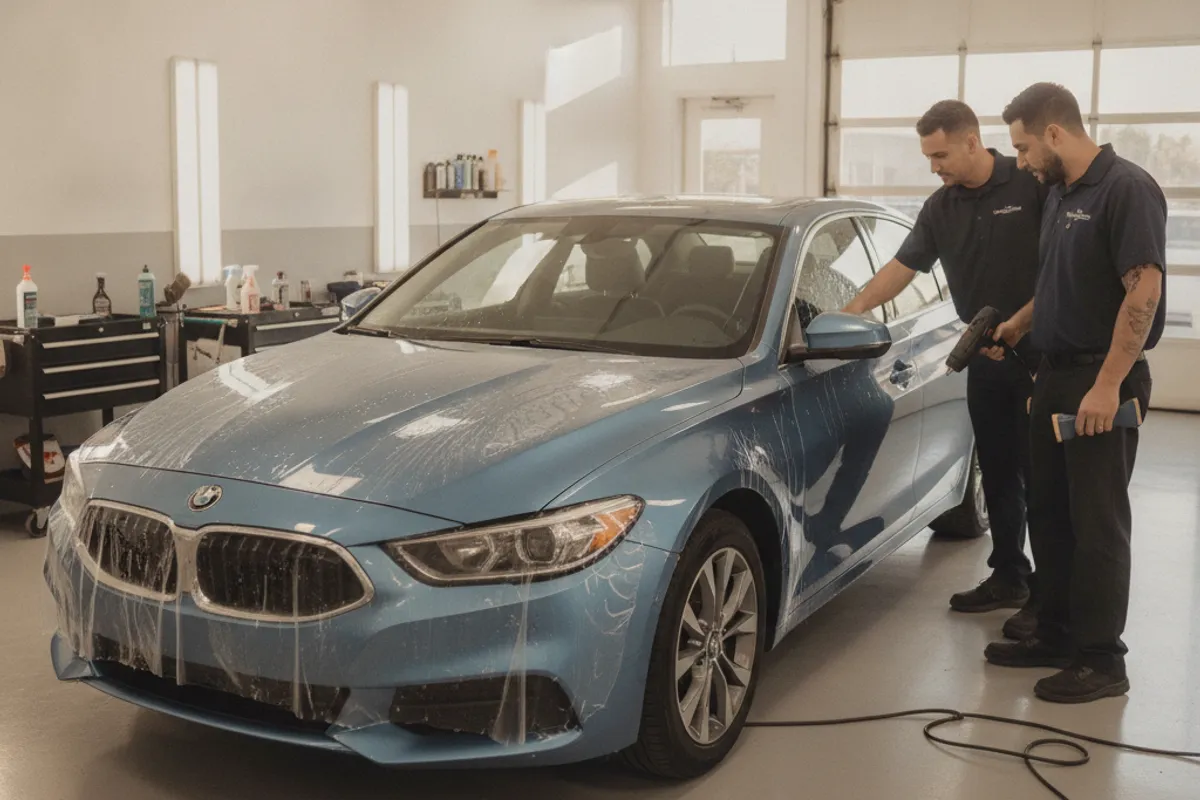
What is the difference between full front and full body PPF?
Full front PPF and full body PPF are package labels, not universal panel lists. A full-front quote commonly names front-facing panels, while full-body coverage extends to the painted exterior surfaces listed by the installer. Compare the exact included and excluded panels. PPF projects on this site carry an approved broad market range of $800-$8,000, and your installer confirms the written price.
The choice is not really about how much protection is better. It is about where your car actually takes damage. For daily freeway drivers the damage is concentrated on the front. For cars that live in parking structures, tight garages, and busy urban areas like Hillcrest or North Park, door edge and rocker damage is as real a concern as chips on the hood.
What does full front PPF include?
Full front protection typically includes the front bumper, full hood, front fenders, side mirrors, and A-pillars. Some installers also include the headlights, and some add the leading edge of the rear bumper where cargo loading causes abrasion. Exactly which panels are in the package varies by installer, so get the panel list in writing on the quote rather than assuming.
This coverage targets the front-facing panels an owner wants protected from road debris. Use the chips and wear already visible on your own vehicle to guide the discussion.
Ask for an itemized price tied to the panel map, product tier, edge treatment, and preparation. Your installer confirms the written price after assessing the paint.
What is partial front PPF, and is full front better?
Partial-front PPF covers only the portions of the front panels named on the quote. Full-front coverage extends farther across the listed front panels. A partial panel can leave a visible film edge, so ask the installer to show where every edge will fall.
Value depends on the panels you care about, the visible wear on your car, the quoted edge treatment, and your budget. Ask your installer to show where each edge will fall before you decide.
How does full front PPF differ by body type?
The panel count and the film area change with the shape of the vehicle, which is what moves the price inside the published range.
Sedans and coupes are the least expensive full front install. The hood and fender area is smaller and the surfaces are relatively flat, so film waste is lower.
Pickups have a large flat hood and tall, squared-off front fenders, which puts them at the upper end of the full front range. Trucks also take more chip damage on the leading edge of the hood from following at highway speed.
SUVs, crossovers, and minivans can have different panel shapes and film areas from sedans or pickups. The installer should measure the actual vehicle rather than price it from the body-type label alone.
Hatchbacks are close to sedans on full front. On full body, the rear hatch and spoiler area often needs extra film sections around the wiper and badge cutouts.
For any body type, the honest answer on price is a range until someone measures the car. Getting matched with an installer costs you nothing, and your installer confirms the written price in person.
What does full body PPF include?
Full body protection extends film to every painted exterior surface: rear bumper, trunk lid, door panels, rockers, quarter panels, and roof in addition to the full front. Some packages add the door cups, which are high-wear areas on any frequently driven car.
Broader coverage may matter when the owner also wants film on doors, rockers, quarter panels, and rear surfaces. Film does not prevent dents. For an existing ding with intact paint and workable access, a pro can assess whether paintless dent repair fits.
The written full-body price should reflect the exact panel map, vehicle, film tier, edge treatment, and preparation.
Which coverage should I get?
Mostly freeway driving: Review the wear already visible on the front, sides, and rear. That evidence can help you decide whether front-only or broader coverage fits your vehicle.
Mixed freeway and urban driving: The case for full body grows when the vehicle is regularly navigating parking structures, narrow streets, and valet situations. In Gaslamp, Little Italy, Hillcrest, and La Jolla Village the risk shifts from rock chips to low-speed contact damage on door edges and rockers, and that damage happens in the parking lot rather than on the freeway.
Higher-end or enthusiast vehicles: On a car where resale value is a real consideration, full body makes economic sense once the cost of refinishing a single panel approaches the price difference between the two packages. Panel refinishing is quoted by the body shop, not by us, and matching metallic or pearl paint on a complex panel is the expensive part. Get that number from a body shop for your specific car and color before you treat it as the deciding factor.
New cars fresh off the lot: The investment logic is strongest when the paint is in factory condition. Full body on a new vehicle means every panel starts, and can end, its ownership cycle in clean condition. This is particularly relevant in North County coastal communities like Encinitas and Carlsbad where vehicles are held longer.
Can I add full body PPF later?
Yes, subject to the condition of the paint and any products already on it. Existing wax or coating can interfere with film adhesion, so the film installer must specify preparation before adding coverage. Ask for that preparation and price in writing.
The cleaner approach is deciding what coverage you want upfront and doing it in one installation. Discuss the staged option with your installer to understand whether they recommend it for your specific vehicle.
Does the film product matter as much as the coverage?
Yes. Coverage area is only one variable, and the film tier matters as much as how much of the car it covers. Professional film lines differ in optical clarity, thickness, and how the topcoat handles light surface marks, and they carry different written warranty terms. Entry-level and unbranded films may not offer those properties at all.
When comparing quotes, ask what product line is being used, ask the installer to name the manufacturer and show where the shop appears on that manufacturer’s certified installer list, and confirm the warranty is backed by the manufacturer in writing rather than only by the shop.
Frequently asked questions
What does full front PPF include?
The front bumper, full hood, front fenders, side mirrors, and A-pillars, with headlights included by some installers. The exact panel list varies by shop, so get it in writing on the quote.
Is full front PPF better than partial front?
It depends on the quoted panel boundaries, edge treatment, visible wear, and budget. Compare both panel maps on your actual vehicle.
What does full front vs full body PPF cost in San Diego?
PPF projects carry an approved broad market range of $800-$8,000. The actual full-front or full-body price depends on the written panel map, vehicle, film tier, edge treatment, and preparation. Your installer confirms it after an assessment.
Does full front PPF cost more on a truck than a sedan?
Yes. A pickup has a larger flat hood and taller front fenders than a sedan, so the film area is bigger and the install sits at the upper end of the full front range. Sedans and coupes are the least expensive full front install.
Is full body PPF worth it if I mostly drive the freeway?
Review where your own vehicle shows wear, then compare the additional panels and price in the full-body quote. Driving and parking patterns can inform that choice, but they do not produce one answer for every owner.
Do I need paint correction before PPF?
It depends on the paint’s condition, because film locks in whatever is underneath it. A new car in factory condition often needs only decontamination, while an older car with swirls usually needs correction first. See paint correction before ceramic coating for how that step works.
For a complete overview of how PPF and ceramic coating work together, see the paint protection film service page, the full front PPF package, and the full body PPF package. To get matched with a vetted, insured installer anywhere in San Diego County, call (760) 400-6557. Getting matched costs you nothing.